The Rule of Synergy: Three Have to Have Accelerators

“The whole is greater than the sum of the parts.” Phil

Engage others in creative and synergistic endeavors.  Purposefully find ways to force team member interplay for power results.  Be sensitive and firm.  This is not a day at the ropes course.  This is in the work place on real tasks that have real risk of failure and real potential for success and reward.

“Ineffective people live day after day with unused potential. They experience synergy only in small, peripheral ways in their lives. But creative experiences can be produced regularly, consistently, almost daily in people’s lives. It requires enormous personal security and openness and a spirit of adventure.” Steven Covey

It takes a LEADER: Good executive leaders understand this rule.  Leadership is required.  Manager thought tends to avoid this risky behavior. Lead.

Personal Security: The workplace should ooze with personal security and powerful self esteem and a sense of individual dignity.  Of course it might not be happening where you lead.  Then you need to work on it.  People need to understand accountability and responsibility and the safety of making mistakes from which we learn.

Accountability means I understand my actions and results impact all those around me and I account that into my decisions.  Others will hold me accountable for what I do.  They will rejoice in tandem, forgive forthright mistakes, and hold me responsible for results both individual and together.

Responsibility means my action will impact me directly.  I get it.  I understand it.  I welcome it.  Good or bad results, I am responsible for my actions.

Personal security can only be reinforced in such a dual environment.  Many lack personal security and are looking for everyone from mom and dad to the government to supervisors to take responsibility for their success or failures.  Those people cannot thrive in synergy at optimum levels.  But they can start where they are, grow, and experience more daily.

Openness: Every team has to find the place of what Jim Collins calls, “brutally confronting the facts.”  It is not negative.  It is a direct and non-personal approach to dealing with the blips, glitches, misstatements, wrong turns, customer complaints, and missed deadlines.  Dancing around the issues because a team member is overly sensitive inhibits synergy.  You have to want synergy.  You have to desire synergy.  You have to yearn for synergy to get past covered conversations into open, intelligent discussion.

Spirit of Adventure:  A community leader speaking at a business leaders’ lunch asked for a show of hands.  “Who loves to do things with uncertain results and a high risk?”  Only one hand among 450 went up.  “Well”,  he said, “that is the definition of adventure.”  Among all of these senior executives, bankers, lawyers, CEOs, and wizened warriors of the workplace, the sense of adventure had died.  For synergy to happen every day, the third ingredient is a spirit of adventure.  Individually and together the team needs to led into a continual spirit of adventure.

On a powerfully synergistic team, a client came with a bothersome technical improbability.  Theoretically, what they were doing should work.  But, it was failing at several levels of production and the supporting vendors had sent them to us for resolution.  After some frustrating attempts, one of the team just would not let it go.  He tested and tried and worked with the other members to come up with a solution.  At first, we discovered how to force it through our production engine, but only with effort.  Then synergy exploded.  A simple solution was implemented that allowed the originating production shop to perform without having to upgrade their equipment or outsource the job to us.  Our team invented themselves synergistically out of a job that was highly profitable.  Openness means honesty.  Sense of personal security means do the right thing for the client.  Spirit of adventure means taking on the improbable and finding a way to do it anyway.

Go back

Your message has been sent

Warning
Warning
Warning

Warning.

The Five P’s of a Manager’s Portfolio Allow Right Building

The Five P’s of a Manager’s Portfolio Allow Right Building

Assessing a business operation takes scrutiny of the right five P’s.  Get it wrong and you can find yourself damaging more than building.  Get it right and the right stuff comsolum3des together.  Look to the heart not the surface.  Uncover riches.

Character is like a tree and reputation like a shadow. The shadow is what we think of it; the tree is the real thing.  Abraham Lincoln

First Things:  Begin with the end in mind.  This is another article, but you need to be reminded before you look into the P’s.  Every operation includes an objective to be measured and met.  Don’t look too deeply into the organization before you determine this item.  Otherwise, the P’s, which may be out of position, can lead you to wrong places.  If they were perfect, why would anyone need you?  They must continually be adjusted to measureable objectives.

People:  Take time to review the people set.  Are the right passions, personalities, and portions (skills sets) on the team?  Is this set to succeed or set to fail?  Has this team been intentionally built and honed or sporadically pieced together?  What will it take to realign and make productive?  What is missing?  What is unbalanced?

Props (Tools and Technologies): Examine the tools and technologies in the operation.  Are they current?  Are you trying to hit a big hairy audacious goal with skinny, smooth banana peels?  Has the shop been kept upgraded or held back with cost cutting for years?  What will be the investment?   Is the team “too techy” and loaded up with an oversupply so that no tool is really mastered?

Processes:  If you can’t document the processes clearly, you don’t know what you are doing.  Deming said something similar to that.  He’s right.  In one shop, it took two years to get process documentation settled.  Development teams kept changing the underlying processes without ever settling on the existing.  No one really knew what a good result at the end of the day looked like.  After documentation was settled, the team performed smoothly and on time every day according to company needs.   This is a touchy and tough area to address.  Don’t avoid it.

Projects:  Projects in motion reveal major needs if they are rightly designed.  The lack of defined  projects is a sure sign of a disparate, disorderly, and dying operation.  Are capital improvements in motion?  What services are being designed for future delivery?  Is there a training program?  Crosstraining?

Products and Services:  Well, why do you exist without these?  Service catalogue?  Do the focused customer groups know how to get great service and what service is available?  What of these are core critical to the overall organization?  Why?

Summary:  If you take these five P’s and write down three notes, you have the beginning of a great business plan.  1. What is the inventory or status of the P?  Make a list of the items and critical criteria, benefits, advantages, and demographics.  Assess alignment to objective and need. 2. What needs changed?  3. What is the impact on the other four P’s when I change it?

That’s enough for now.  Business is building.  Never stop building.

Excellence Starts Here! Three Tips For Top Performance. Engaging Ingenuity.

IMG00354-20100730-0810

These two gentlemen represent a great event in a production shop.  What really is the beginning of such powerful events?  Oh, the event?  The team had kept key equipment up and running and productive for 30 days with no vendor calls.  Amazing.  Especially considering the fact that prior to this the equipment required calls every 2-3 days for many years.  They are holding an award for the historic event.  Now, back to the question.  What really is the beginning of such powerful events?

Think about why you need these events?  A friend used to call them “Big Days”.  Big Days build strength in an organization, overcome defiant obstacles, and release energy of the team in a positive manner that is brooding in a negative manner.  For those reasons alone, you need to engage the next three points.

One: Get dissatisfied.  Yes, that is the beginning of all great change.  If you are comfortable and content, change is a threat.  You must engage vision for the future with passion and be dissatisfied with the status quo.

Two:  Spread your dissatisfaction.  Now, you don’t need to get people upset over nothing.  But if the people you are serving can’t get their jobs done or their product delivered or their services received on time, you need to get some partners in your dissatisfaction.  Other managers, co-workers, staff, key customers, executives and others probably are already dissatisfied.  Let them know you understand and listen to their view points.

Three:  This is where real change starts.  Pick a key point over which everyone is dissatisfied and attack it with passion and purpose.  Dig for a root cause that will help everyone in the process.  The theory of constraints explains that when you dig out a major point of constraint, you loosen up other constraints to become visible so they can be resolved.  In other words, break the dam!

You will be amazed.  This team went into overdrive for customer satisfaction when they found this one barrier to productivity resolved.  They annihilated this bothersome downtime issue on key machines, developed new procedures for maintaining the equipment, gained independence from the vendor, improved production turnaround times, and improved the entire shop morale.

Just a thought today for those looking to do something good for themselves and those they serve.

Go back

Your message has been sent

Warning
Warning
Warning

Warning.

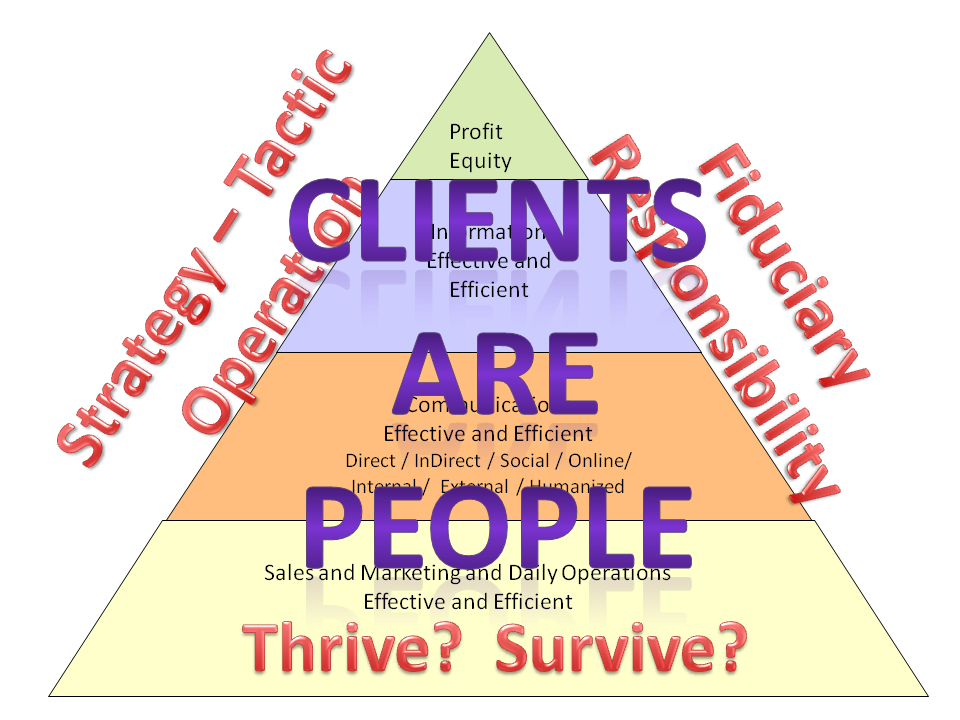
Exec/Direct: Effective In House Printing: Customers Are People

Image

Changing Views

A large retailer directed that every time the word “customer” appears in their marketing it was to be replaced with “people”.  Dehumanizing people is a common characteristic of service organizations.  Historical IT organizations like the term “user” for those that come to them for service.  In Plant and other inside department service teams can get lax in how we view those that provide for our livelihood.  Maybe over time the word “customer” has become too common.  Smart organizations serve people.  People need relationship.

Celebrations of 100%

The phone call was from the manager of one my largest customers.  Usually that call meant some service glitch had occurred.  This time it was different.  She called to tell me that her group had been doing 100% of their business with us for the last six months.  She had not told us.  She had just done it.  Her team loved it.  They loved our people.

Could she come and have a surprise party and celebrate with the team?  Her team and my team together?  Of course.  I love the pictures of that moment.  The smiles had taken years of service and listening and adapting.  But here they were.  These moments are repeatable.

Organizations Are Different

In the university organization relationship development with Athletics, Admissions, Administration, Alumni, and Academics brings big results.  A good friend with over twenty years of good success in a private university taught me that cultural specific.  People have cultures and ways of grouping themselves.  Be attentive.  Both at the executive and ordering customer level, this is critical.  Universities have their own culture that needs stroked and attended.

In corporate America relationship development can vary greatly.  But every organization has the C Suite.  CEO, COO, CIO, CTO, CSO, CRO, CMO, and CFO have some commonalities and some differences.  Executives look for risk reduction, human resource optimization, cost containment, budget stability and predictability, and revenue growth.  Those are common concerns.  Yet, ever executive has a focus area.  Marketing, finance, sales, information, security, risk, operations, technology, and the Executive Officer each have nuances of interest alongside the commonalities.  A smart In Plant studies and meets the needs of the executive organization.

Family companies can differ from stock public owned companies.  The dynamics are different.  The people act differently and have different priorities.  Get specific to your organization.

Industries can differ.  An insurance or finance oriented company looks at minute details and tends to attract analytical managers.  A retail organization is geared for change and adaptation.  Smart departments adapt to the differences evident in the people in the organization.

So How Do You Humanize the Customer?

Working with a university in-plant, my estimate is that they can double and even triple effectiveness and “share of wallet” in existing relationships by tuning into the “voice of the customer”.    Too often, we get focused on the differences we have with those that come to us for service.  Why not look at the similarities?  Why not find the connections we have and commonalities?  Humanize your view of the people you serve.

They have a message to deliver to a group and a response they would like.  Whether it is a course pack for a law professor or a direct personalized mailer for a sales organization, there is a reason for the communication going out on paper and a response that is wanted.  Isn’t that what all of us do all day?  We communicate in order to get a response.  Focus on what that person is looking to accomplish.

The people you serve have demands and pressures.  Sound familiar?  The In-Plant is constantly pushed to deadlines.  It is the last lap in a long race for any organization or company.  The people who we serve are under similar pressures to perform.  Relate.

The people you serve have families and lives outside of their work.  When working with one marketing manager, it was joy to listen as she shared about her husband and children and community activities.  They were different priorities than my life, but most similar in many ways.  The relationship built understanding from family to the work place.

Gain Efficiencies on Trust

Steven Covey is known for his premier work on the 7 Habits of Highly Effective People.  His son is known for his work on the Speed of Trust.  Trust built through relationship can enable great communication between “customer” and “service team”.  End to end high speed communication chains in a print service team and customer relationship ensures minimum loss of time and minimum waste in execution.

Enabled service that lives in a humanized relationship with those served provides a value to an organization that is inestimable.  The value of those that serve with the maximum vested interest at heart of those they serve as people not “users” cannot be measured in dollars.  The people served are empowered at a new level that just is hard to convey.  Those people end up bringing double to quadruple the business to the service team.  Maybe you can have a 100% party.

Exec/Direct In-Plant Thrive – Online Optimized

ImageOnline support and pdf workflow stabilization:

The fallacy still exists in the print services industry that you can get by without big feature online services.  You can’t.  Any executive or manager that is looking to improve performance must attend to this item.

A good online and pdf workflow system with right features for customers and production and administrative can drive significant costs out of reworks, job loss to competitors, and lag times on projects.  It also can bring in a constant flow of repeat business and give you a competitive advantage.  You can establish a clear differentiation from competition and integrate your production workflow with the customer workflow.  When they order, you can be the only option on their mind.

Inside the shop, there is an amazing turnaround improvement as wasted hours of looking for information are reduced and the status of every job is known at every moment.

For the administrative team invoice and chargeback information accuracy improves and historical analysis of product mix performance by customer and product type becomes available.

Fear, Uncertainty, and Doubt

Why would you not move into this world?  Confusion over what you need leads the biggest fear factor.  Fear of a long project implementation that fails is another uncertainty area.  Doubt that your team can pull off the project correctly is another block to productive adaptation.

What online support is not.

Online support is not an ftp site with a little file information.  That is primitive and is what most print providers call online ordering.  If that is all you have, you need to move forward rapidly to find a more featured solution.

Online support is not job costing with file attachment.  Again, some have moved a step up the chain and adapted to at least give customers some added information.  However, most of those serving and most of those ordering are fully aware, the price at the delivery rarely matches in these type systems.  Customers need accuracy.

Online support is not an order system that resists integration with the other major processes of a production shop.  This can be frustrating.

What is going on in most shops?

In many shops those three represent the extent of online ordering support for the customer and the staff running the shop.  Every executive and manager can improve services for the organization and for the customers by going into a big feature online ordering support.

What does real online ordering and pdf workflow look like?

Okay, get your pencil out and begin to go over the checklist.  In the next ten years, you will be converted to this way of thinking or you might just not be in the business anymore.  It amazes me how much we resist the power of good ideas.  You need to demand your online software vendor support what you are getting ready to read and you need to demand your in-plant find a cost effective implementation for you.

  1. Online ordering requires acceptance of file upload of supported standard file types.
  2. A good system will archive prior files ordered and allow reorder without reupload.
  3. Catalogue collection and customization by client group.
  4. Variable customization of certain orders for dynamic build of post, brochure, business cards.
  5. Look and feel by client group ordering.  Make it personal for the client.
  6. Tight security and separation of file storage.
  7. Dynamic status of order reflecting whether the order has been moved to press, finishing, or shipped.
  8. Content lockdown with marketing, legal, compliance, and any other customer required approvals.
  9. Great systems have fulfillment for non-print items and high demand print items.
  10. Great systems are integrated into automatic invoicing.
  11. Great systems are integrated into shippers like Fedex and UPS for single reference from order point to receipt by the customer.
  12. Great systems have production integration for the shop so internal service can monitor all orders from a single console.

So, what is keeping the industry from running forward?  Automation leaders like VistaPrint and Shutterfly have proven value of powerful online systems.  Of course, an in-plant is not purposed to serve the world with such product, but they can certainly improve the purpose they serve.  There are some tremendous in-plants that have brought incredible value to their customers and owners through adopting online.

Get with it.  Find a way to implement and milk the value out of online and interactive custom ordering services.

FUD Removers

Yes, you do need to deal with the fear, uncertainty and doubt.

  1. Develop a list of criteria.
  2. Talk to key stakeholders in the customer areas.
  3. Build a shortlist of acceptable vendors with an RFI (request for information).
  4. Produce a product list that would be supported with expected sales growth by product.
  5. Calculate waste reductions with a LEAN DOWNTIME approach.  That is another article.
  6. Go for it and make your customers happy.

Light Bulb Moments – Empowered In-Plant Printers

What was that “light-bulb” moment that had the greatest success on your operation?

People serve people?

Online really does work?

I can help others grow?

Go back

Your message has been sent

Warning
Warning
Warning

Warning.