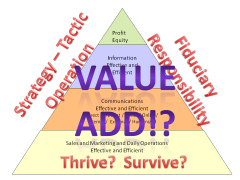
Reviewing the cost power of in-plants is important for any executive wanting to make key decisions regarding cost and value and profits. Many make the mistake of simply categorizing in-plant production as a cost reduction or expense area. That can blow costs up in many other areas of the company. However, an inefficient in-plant that has not worked hard at value add may provide cost reduction after all. Unless, you work on the value add.
Profit leaders in commercial print plants keep Value Add at 65% or better. An In-Plant can do better. I’ve seen plants up to 85% where materials are not of high significance. Part of the problem is that corporations and organizations outside of manufacturing don’t get the concept. Even companies in manufacturing forget to apply costing and planning principles to individual departments that are applied to the entire company profit and value calculations.
What is Value Add?
Value Add is simple. Value Add is what your shop produces minus materials (paper, ink, plates) and minus what you shop out and outsource to others (mail list handling, large runs, design, etc…) When you shop out the work, you are not adding value for the client, the departments, or your business. Someone else is adding value. It devalues your overall business proposition.
Managers and executives, no one can do 100%. We need to measure today and work to move it above the 65% line. This is long term value for you as a business. You can be making profits off of this work and improving your single source provider influence in the mind of the customer. Customers want to go once place and get service from you, the provider that understands their needs.
So Where Can You Improve an In-Plant Service?
Simple. Ask the people sourcing work out of the company and organization.
Are there posters and banners and event collateral being serviced down the street for three times what could be produced in-house? Trust me, if you are doing these types of work and not enabling the in-house team with equipment to produce, you are losing money. It is costing you profits.
Is direct mail being serviced outside? Your in-plant should be working to integrate that into their digital offering. If your in-plant is already out-sourced, you should challenge the provider in this area.
Are you supporting online and variable print collateral across your organization? It is expensive out of house. A committed in-house or commercially provided in-plant can make that area work excellence for your organization.
What does your organization need?
Are you doing finishing at a secondary site and adding confusion, less reliability, and production lags in delivery? Think it through.
As an executive, you should be challenging the provider whether your in-plant is in-house or commercially provided. As an in-plant manager, you should be actively seeking product and services that build the value of the offerings to the business or organization.
Value Add builds business value, expands worker capability and contribution, and reduces production mix ups and lags due to outsourcing.
Next up? Product Optimization… a real place to get costs down and profits up.
Before we take a look into the six areas, let’s look at why these areas need addressed.
What is driving this fear of out of control print and media costs? What worries the executive? Pain points to the problem. It does not always point to the solution.
Marketing Disconnects
There is a valid fear among CFOs that continued dollar loss is unavoidable in print and related communications services. Studies show that in excess of 70% of CEOs distrust the marketing engine. The inability of marketing and communications areas to relate expenses back to profitable company growth stymies a financial analysis. Why settle for this? There are gains to be had. There are profits to be built and encouraged. The activity can be and should be measured with a hard look at Return on Marketing.
Media Proliferation
Another pain point is the threat of new media channels and mobilization demands. Marketers and executives alike tell analysts they are afraid they and their organizations do not understand what they need to know to adapt. They are thrashing and reading statistics of other attempts in similar organizations in disbelief and despair. What to do? Where to start? How much to spend? Will the long term value traditionally obtained through customer loyalty and persistency be affordable? How many channels of communication need to be engaged to be effective? Which will be life threatening if you don’t engage now even if the expense is unmanageable and lacks decent measurement points?
IT Collision Course
Add to those two the collision of IT and marketing that plagues most companies. IT has been the technology driver and owner of control of data assets. A continual emphasis on security and access and controls has made the information inaccessible and hard to understand for most marketers and communicators looking to take deep dives into segmentation and determine relevant categories of buyers on which to focus. Proliferation of disparate systems within most organizations means the data is not congruently analyzed. Add to that mess, the data was accumulated for operational purposes not for human communications and conversation and concern. It is dry and most times irrelevant. To work in the conversational communications of people to people in which marketing happens, the systems of accumulation and the intelligence behind them must be reworked. You cannot take a financial programmer and build a human sensitive interactive analyst. The change does not work in most instances. Certainly attempting to do it in the speed needed by marketing and communications and sales tasks most companies well beyond the capability of their human resources departments.
Late Adoption of New Media Marketing
Face it. You’ve waited too long. The competition is racing and working with new media and you just got your facebook presence online. It is static and not getting feedback from the right people. Forget about customers in this world. Focus on people. It is people that buy your products. And they are not talking to you. You have done something, but it is just not working. How do you leap frog over the inaction of the last few years when you should have been an early adopter?
Summary and Setup
If you agree with the dilemmas posed above, you know you have to do something about that massive print engine. It is a powerful tool in the Marketing 3.0 Blueprint. Trust me. All those other channels need print to bring them to life. That is one of the lies of the technology thought base. If you buy a lie in the beginning, you will suffer and suffer and suffer. Print is not gone. It is radically changed. It is interactive. It is humanized. It is responsive and direct and timed. It is focused and integrated. Using it in flat and traditional manners will get you decreasing return on your marketing and sales dollars. You need to optimize the engine and take quick advantage of the power of customization and integration of print media with other channels of communication. It is not cheaper to skip print. It is foolish. Neither is it smart to print like you have been printing. That won’t work. You need a new print engine that is dynamic, customized, interactive, data driven, communicative, and humanized.
Next Installment:
We will begin to look at the six core areas that must be addressed in a print engine overhaul to build the powerful and competitive approach for your organization. You must.
Discussions with shops around the nation result in a few inevitables.
1. How do you get people to move forward?
2. How do you get other people to move forward?
That is a purposeful pun.
It really gets to be all about people in our efforts to change products and processes. Those changes always mean changes in people, projects and props (the tools and technologies). But the people are in the center of it all.
Product change means marketing and selling customers and investors. For an In Plant, they are the same. Customers are investors. They are the source of income and many times the only source. Sure, the CFO, COO, and CEO have strong opinions and input especially for transactional product lines. Yet, more and more effective print and distribution management for In Plants must engage the Marketing and Sales customers. That is high powered growth. Transactional has a high likelihood for being sourced and reduced significantly. You must move forward.
Process change is the same. Your highest sell is to your internal production teams. Next comes the customer. Many processes can be changed without engaging the customer. Yet, you need to ask yourself why you are doing changes if the customer does not benefit? They have an interest, even if it is just to know you are working on cost improvement or cost containment for them.
Prop changes are for the products and processes or they should not be done. Nuff said. You should not be retooling just to get the next fancy wangamahoochie. Technology must meet real business demand to go through the pain of change. Your production team must understand how the customer will benefit along with the product and the process. Your production team should improve skill and contribution and have more fun when you change technologies and tools.
Projects are what implement changes. Have them or die. A defined way to analyze, define, plan, implement, and optimize goes with every change. There are budget approvals and customer approvals and departmental approvals and worker approvals and self approvals and vendor approvals and IT approvals and on and on and on that must be planned and coordinated along the path to productive and prosperous change.
So people are involved in every step and every area of change. Those murky, hard to understand, mental, emotion, physical, and spiritual beings can make change heaven or hell.
Just for fun think of four types you will encounter.
Mundane Mary: The person will ask question after question. She will want to understand the universal and specific reasons for the change. Put her on the analysis team with a specific deadline. She might drive you insane, but she might find a hole in some plan that saves your hide.
Slap Happy Sam: The person will want to implement without a thought. Every day is an opportunity for a new party. He can get inclusion guaranteed as long as he is armed with a few facts to support his sales of you and the project. Make friends with him. Get him to understand how this change will improve happiness for someone.
Hard Ball Bart: Whew.. he will want profitability or cost reduction. This guy is important. He will make you justify in the right manners. Convince him. Do your homework.
Amiable Amy: She just want to get along. So make sure she is on the implementation and training track. She will work until it works for everyone else.
This is a blog not a book. So I am ending here. Just some thoughts to stir you up on the path to progress.
GraphExpo exposed some new opportunities for In Plant and commercial and hybrid operations. The print services provider of the moment is fast becoming the communications provider of the future. There are incredible opportunities.
New opportunities: More than one spot featured what I will call, “Talking Paper”. Ricoh featured this and DocuMobi (now loaded on my Android and I hate loading new apps). It is the image that is recognized instead of a barcode. A good idea if the readers become integrated I can just use one scan and my device figures out which source I need quickly. The interactivity of the quick video with documobi is a blast. Print with a smile. In fact, DocuMobi was using Direct Smile in the mix.
Next up was a great development. More than one press manufacturer had mixed roll paper feed into multiple option feeders. How I wish I had this six years ago when 75% of the paper I was using was one type. The inability to mix roll and cut sheet is frustrating for most shops. Kudos to the front end company that is making this possible. I did not delve deep enough to know which one it is.
Social interaction. Not social media. Social social. IPMA and Print Media Centr both had open booths. The playability at the PrinterVerse was oustanding. What a refreshing step away from the vendor hawk areas. Vendors take note. Provide a place where no sales people are allowed and people can just enjoy. One of my great friends in life is Emerson. No, they have nothing to do with printing or communications. They provide power systems. Every once in a while they provide a few days in a non typical convention town where only their engineers are communicating with customers. They mix education on trends and build great relationships. Kudos, GASC.
More fun? Ricoh gets the all out award for creative display. That town center was a blast. I wish I had four hours just to walk around. I sure hope you caught it on pictures so I can redo a virtual tour with easy drill down into the shop windows. Wow.
As Gomer would say, “Surprise, surprise, surprise!” Right in the middle of Konica Minolta is EngageIT. I love EasyPurl and Mindfire and InfusionSoft and Interlinkone and Xmpie, and, and… anyone who mixes up the channels in easier ways for printers. This product looks to be a game changer. Written by a gaming ad agency, it has simple abilities to make it happen based on realistice patterns of interactivity. And you don’t need rocket scientists in your shop to make it work.
In Plant education was a phenom. Much thanks to GraphExpo for courting this audience that makes up a bigger and bigger portion of the industry. Sorry commercial guys, if you don’t learn how to in plant, you are going to go away. More and more companies get it. The digital revolution brings ability for volume, quality, variability and impact in smaller and smaller and more affordable packages. The need for mass volumes and monster equipment is waning. Companies that have never thought about In Plant operations will start thinking. Those that have them have begun serving others. The education options were superb and dead on. The In Plant folks had fun, learned, and were exposed to new possibilities. I talked to many of them. They are ready to grow and take a bigger portion of the market.
That’s enough for today. Just a little reporting on the fun side.
Over decades of assisting companies in healthcare, insurance, non-profit and retail, there are three essential adaptations that always play. For improvement to stick, you need the right stickem. Stickem? Remember the old glue sticks as a kid? We called any type of glue out of a pot or a stick, stickem when I was a kid.
Adapt Staff:
That’s right. Start by adapting staff.
Raise Up Others. It is so easy to let folks down. Find a way to raise them up. You will grow when others grow around you. You stand on their shoulders.
Replace Yourself. It is essential that find others to replace your skills and expertise. Probably one of the most frightening activities of your career will be replacing yourself. What if “they” don’t need you anymore after you replace yourself? There is always someone looking for a new leg up, a new improvement, a new approach. There is a promotion waiting for the right person who is free because of great management development of others.
Visiting with one shop ten years after working with them was enlightening. One of my early hires during reengineering had risen to become the shop manager. We were visiting at a national conference over a cup of coffee. He looked me in the eye and said, “We still use the PAL method.” Puzzled, I asked him what he meant by the “PAL” method. He explained that I had initialed every new memo and organizational tip and note with “PAL”. Those are my initials. He and others had learned concepts of operations and improvement through those notes and continued using them ten years later. They did not need me, they had learned me.
Reinforce Service. Get that team to engage a full service mentality. In Plants and In House operations have bad reputations for service. Do whatever you can to find a new service mentality. Never rest on service. Years of acculturation can kill service. You find yourself not hearing what you really need to hear.
Adapt Products
The same old tired product line is unexciting to your organizational customers. They want pizzazz and look and feel and different sizes and approaches. Sure, there is a penchant to live within the norm at every organization. Trust me, the norm is boring. You need some spice in your product line.
A recent in-plant manager talked to me about finding right support product for banner stands. A year ago, there was no capability to do banners. Now, the largest customer was demanding access to the new product line and they wanted it in volume repetitively. Foresight to acquire equipment and train staff had turned into a “have to” product line.
Find collateral services that accent what you already do so well. Can you add multi-channel support of email and landing pages to your direct mail? Can you add direct mail with variable impact to your brochure printing? Can you add online ordering and fulfillment on-demand to static box shipments of marketing collateral? What can you add that makes sense?
Customization is a must. Everything you do needs variable integration and segmentation design and capability.
Challengers in other departments, companies, other thought leaders, the market, all these need to be attended and addressed. Expect them and respond with wisdom and research and cooperation. Some of your biggest supporters will get mad when you launch a new product that helps another supporter. People just like to be in control and keep it all compartmentalized. That is, until they need something new that you don’t supply. You have to lead and laugh and remember they will come demanding more after getting upset that you grew.
Adapt Marketing Speak
Adapt your language and approach to each different audience. It is amazing how many sets of ears exist in our limited universe. Each has words they love to hear and ways they love to see information. Become an expert at telling the same story in multiple ways.
C Suite listens to different actions and words than your staff. These are results oriented, cost reducing, compliance happy, and culture protecting individuals. Speak the language. Make the emotional and logical connections with them. Help them see. They have seconds to assess new information, not hours. Be brief and positive.
When working with a client to add a product line, we had a C suite luncheon. Using new techniques of landing page survey, we acquired food and drink preferences. At the luncheon all the food and drink was ready and organized by name. C’s came into the room expecting a normal corporate cattle line. They received custom service. As the client presented the new information ears and eyes were open and ready for new input. The client took orders for that product line continually over the next year out of that one low cost personalization that touched the C suite ego. One top executive mentioned that luncheon a year later. To him, it was the most professional he had been treated in 30 years of leading his corporation.
Your customers don’t care what you do for others. They just want to know what you do for them personally. Find that one product line or service that is most meaningful to them and make notes. Find a way to make it appear easier at the right time on the right day. Find ways to customize and improve it.
Working with one client, we modified a “book of forms”. They were shipping these to each new customer. Through some simple cooperation with the IT web folks, we created a custom variable post card mailer using mainframe data feed. Everyone struggled with the concept. The forms went to online download. The cost went down over $120,000 a year. We kept the customer for the client. Other business that came into the shop from that customer more than made up for the $60,000 a year in print that went away.
Influencers are looking for ways to grow their contribution. Show them how you can help them do that. Help them move up in the eyes of their clients and customers. Find out the influencers in your organization and find ways to advance their cause. It is amazing how you can help someone in administration by simplifying business card ordering processes.
Whew! There you are. Here are three essential areas to adapt. Staff, Marketing, and Product all need adapting to move forward. Of course, there are more areas. But without these, the others are meaningless. Love your customers enough to talk to them in their language. Love your products enough to do them with excellence and continuing improvement. Love your staff enough to build them into a better body of service.

 Reviewing the cost power of in-plants is important for any executive wanting to make key decisions regarding cost and value and profits. Many make the mistake of simply categorizing in-plant production as a cost reduction or expense area. That can blow costs up in many other areas of the company. However, an inefficient in-plant that has not worked hard at value add may provide cost reduction after all. Unless, you work on the value add.

 SOLUM SERVICES